

6.5
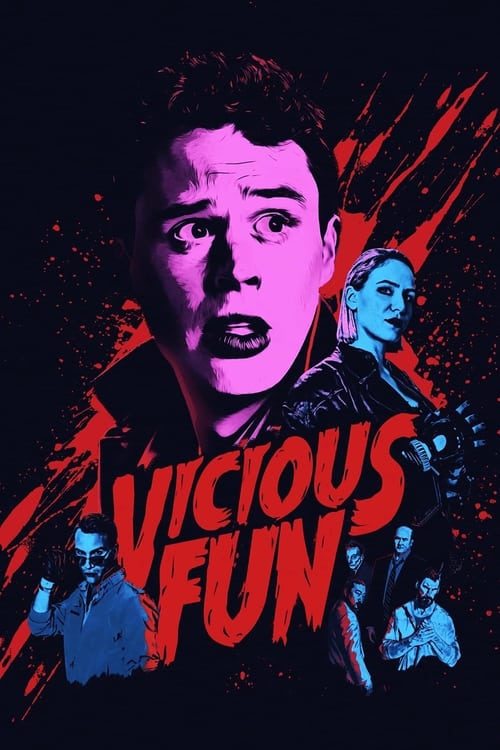
Vicious Fun
2021

Blood. Lust.
An ambitious director sets out to revive a faded slasher franchise, but her meeting with the film’s reclusive original star spirals into a terrifying maze of obsession, fear, and blood-soaked delusion.

An ambitious director sets out to revive a faded slasher franchise, but her meeting with the film’s reclusive original star spirals into a terrifying maze of obsession, fear, and blood-soaked delusion.
 Hannah EinbinderKris
 Gillian AndersonBilly
 Amanda FixYoung Billy
 Arthur ContiAlex
 Eva VictorDJ Ella Giastic
 Zach CherryWill
 Sarah ShermanKris' Agent
 Patrick FischlerRudolph
 Dylan BakerJeffrey
 Jasmin Savoy BrownMari
 Kevin McDonaldAnthony / County Sheriff
 Quintessa SwindellJulie
 Jack HavenLittle Death
 Aren BuchholzThor
 Jordana SummerDoomed Teen Girl
 Ryan McEwenDoomed Teen Boy
 William VaughanSquash Bro
 Hunter DillonChuck





Availability for your region. Streaming data provided by JustWatch.
"Kris" (Hannah Einbinder) has managed to convince some investors to consider funding her attempt to resurrect a dated horror fanchise set at a remote holiday camp. To that end, she has tracked down the woman who was the original damsel in distress in the series's very first outing decades ago. "Billy" (Gillian Anderson) has been fairly reclusive ever since that first success, and has retreated to live at the very camp in which the films were based. Now in the depths of winter, "Kris" braves the snowy conditions to pay her a visit - and her arrival at the eerily silent camp sets in train quite an emotionally and psychologically charged few hours with her enigmatic hostess. I think my problem with this stemmed from the decision of auteur Jane Schoenbrun to put her own experiences front and centre here and rather leave the mysterious substance of the plot to play second fiddle to that. Clearly, this is a film-maker who has had their fair share of struggles to get her often quite eclectically structured (i.e. last year's "I Saw the TV Glow") films funded and made, and so coupled with a sexual fluidity that neither Einbinder nor the underused Anderson are afraid to commit to, this became more of a commentary of a character with whom I couldn't really engage set against an half-baked critique of the repetitious slasher-genre upon which this tries to make it's money. The threads do come together a little more completely towards the conclusion, but I think by exploiting so many of the clichés and photographic tecnhiques of films like "Halloween"; "Friday the 13th" or even the more recent "Black Phone" sequel, and presenting a paucity of meaningful dialogue, this sort of falls into it's own trap of introspective mediocrity rather than "elevating" itself from the more generic quag.
This did not hit the way I thought it would, and I am pleasantly surprised. If you are not into some rather "out-there" stuff this might not be for you, because this is not your average slasher with a fun twist. This is a deeply strange, surrealistic meta-delving 'deconstruction' (gosh that term gets overused) take on the genre, through a strange character's journey. It is a mess and a fun one at that. If you are not up for this rather ballsy and cerebral thing you should just stay away as this is not for you, but if you are in the mood for slasher with a side of mind-bend coupled with some very strange sexual takes, then you should go for this.
# Analysis of Jane Schoenbrun’s “Teenage Sex and Death at Camp Miasma” (2026) ### “I saw ya and wanted to scare ya. It’s only fair, right? You already seen me.” It is no secret that Jane Schoenbrun (they/them) references pop culture throughout their filmography. The Pink Opaque of *I Saw the TV Glow* (2024) was derivative of *Buffy the Vampire Slayer,* while *Teenage Sex and Death at Camp Miasma* (2026) nodded to slasher flicks ranging from *Peeping Tom* (1960) to *Wes Craven’s New Nightmare* (1994) and *Sleepaway Camp* (1983). Beneath the references and homages, Schoenbrun also engages with time, pushing audiences to stay present in their stories and in themselves. By referencing essential slashers and confronting time, Schoenbrun puts their work in direct conversation with the genre’s aesthetics and flaws, using time as an open door to opportunity and rebirth throughout their latest horror film, *Teenage Sex and Death at Camp Miasma* (2026). Schoenbrun crystallizes and confronts their love for the slasher subgenre in *Teenage Sex and Death at Camp Miasma* (2026). It is apparent that, while holding slashers in high regard, Schoenbrun is critical of the genre as vastly male-centered. Most, if not all, weapons in slasher films are phallic objects; statistically, a young female character is often the first to die, and women experience significantly more prolonged, graphic, and severe violence on-screen. Rather than criticizing the genre as a whole, Jane Schoenbrun takes on the challenge of queering the genre. For instance, in *Teenage Sex and Death at Camp Miasma,* the depiction of orifices is prevalent. Little Death’s VHS tape player at the bottom of the lake resembles a vaginal opening. The air conditioning unit on his head is like a portal that still honors the motif of most horror film killers being modeled after blue-collar workers. Little Death even wears a white-vinyl raincoat suit reminiscent of Patrick Bateman from Mary Harron’s *American Psycho* (2000). > e.g., Jason Voorhees of *Friday the 13th* wears rugged groundskeeper clothes; Michael Myers of *Halloween* wears iconic navy-blue mechanic coveralls; Leatherface of *The Texas Chain Saw Massacre* dons slaughterhouse/butcher work clothes. (MorphCostumes Team, “Why Michael Myers is the Ultimate Horror Costume.”) In addition to the previously listed images, Schoenbrun also represents orifices as portals. The barn and movie theater openings, the parting of the silver-screen curtains, and the gas station setting all operated as portals into meaningful chapters of the story. One of the film’s most recognizable female-centered images is the infamous dipping sauce scene. Gillian Anderson’s Billy Presley thumps her pink-painted nail against the dipping sauce flab as Kris Williams (Hannah Einbinder, character pronouns she/they) licks her lips with anticipation. The honey mustard sauce is revealed to the audience before a chicken tender is dipped into its golden wonder. Schoenbrun depicts this otherwise mundane dinner as a ritualistic, orgasmic experience of intimacy between Kris and Billy. The female gaze is further complicated when Billy recounts her first orgasm to Kris. As helpless slasher-flick victims, the femme characters can see themselves through Little Death’s perspective. This queering of perspective complicates what the camera captures, especially in the slasher genre. Rather than objectifying the lead femmes to the masculine, heterosexual perspective, Schoenbrun’s perspective externalizes their sexual repression. This tension releases when they become both voyeur and submissive participants who are aware of the role they’re playing. As they shift between voyeur and victim, the film’s thesis emerges in a brief exchange between Kris and Billy about Kris’s debut feature film. Billy states Kris’s film is a remake of Alfred Hitchcock’s *Psycho* (1960) from the perspective of the shower curtain. Initially, Kris is offended by this interpretation, not realizing it’s the key to their entire experience at Camp Miasma. As Laure Murat once stated in their essay, “What’s Queer about Remy, *Ratatouille*, and French Cuisine?” > “The spatial transgression of hierarchies and the visual omniscience of \[the character’s\] position confound binary constructions while acknowledging their power.” (p. 138) The shower curtain is the translucent barrier between the victim and the slasher. Kris, like the shower curtain, occupies a bifurcated space when they subject themselves to the perspective of Little Death while expressing their sexuality. Upon revisiting the film’s opening, the hack-screenwriter, Kris, enters the gas station with hungry eyes, snagging their favorite candy off the racks. The gas station sits between worlds: both destination and journey. In the third act, having survived the night of terror hosted by Little Death, Kris and Billy return to the gas station to stock up on their gummy candies. These final moments of *Teenage Sex and Death at Camp Miasma* ask audiences to savor their pleasures and desires like candy. There are no clean conclusions for this tale of gender euphoria and escapism. This natural desire for an ending prompts audiences to ponder the story’s moral, fearing they may have missed it at first. By enjoying both the film’s ephemeral sweetness, the consumer accepts its conclusion and, hopefully, the moments that pleased them and felt representative of them. Using evanescent metaphors and making the characters cognizant of the passage of time, Schoenbrun presents a conclusion that denotes progress without answers: Time. Time does not give you an answer. It simply measures. *Enjoyed this review? Subscribe to my Substack (Snowy Reviews, by Yasmin) and give me a follow (@yasminthewriter) on Letterboxd, and see what I review next!*
Horny, bloody, queer, hilarious, and completely unafraid to get weird. I loved how it takes the sleazy summer camp slasher and turns it into something surprisingly personal and sweet without losing all the gore and ridiculousness. Gillian Anderson is having an absolute blast, and Hannah Einbinder is great alongside her. It gets a little too caught up in its own ideas sometimes, but I honestly didn't care. Such a strange, messy, funny fever dream of a movie.
4/10 stars review ratings from me. It feels ancient its like watching Blair Witch Project its just without the camera shocking and screaming that is. Just a faint interest to watch the movie till the end not because in is interesting ... its more like a faint curiosity and thats that.
2021
2024
2015
2026
2023

2024

2015
1985
1998

2022

1990
1985

2014
2019
1993
1999
2022

2005
2008
2022